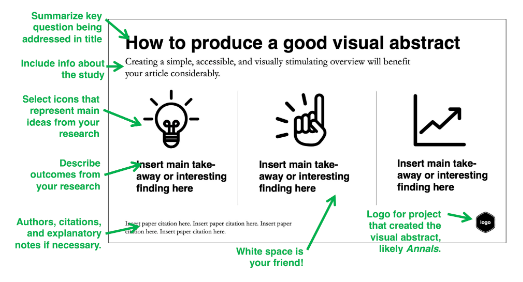
Graphical representation has long accompanied scientific work, but the visual abstract has become especially visible in recent years.
More and more journals now ask authors to provide a concise visual summary alongside a paper. This makes sense. Many readers do not begin with the full article. They usually start with the title, the abstract, perhaps the conclusion, and then decide whether to read further.
A visual abstract supports that process by offering, at a glance:
- the core research question;
- the method;
- the main finding;
- and sometimes the broader implication.
It is not the same as a poster, and it does not replace the paper. Its role is to make the study easier to grasp quickly and easier to share with wider audiences.
In that sense, visual abstracts help both authors and readers. They clarify the work, increase visibility, and encourage more accessible forms of scientific communication.
You get the point, I hope. Now let us see your visual abstracts.
Learn how to produce strong visual abstracts